Editorial
DOI:
https://doi.org/10.5102/rdi.v17i3.7539Abstract
Em novembro de 2001, a UNESCO publicou a sua “Declaração Universal sobre Diversidade Cultural”. Aquele importante documento internacional registra que a diversidade cultural - fonte de intercâmbios, inovação e criatividade - é tão necessária para a humanidade como a diversidade biológica o é para os organismos vivos (art. 1º.). A possibilidade de o ser humano expressar a sua identidade cultural , por exemplo, por meio de pinturas, desenhos, estatuetas, performances ou esculturas fez com que cada uma destas expressões culturais passasse a ser digna de tipos variados de amparo e proteção jurídica. Cada um desses objetos contém impressões, experiências e vivências humanas simultaneamente singulares e coletivas e, em consequência, levanta questões jurídicas de grande interesse e relevância para seus criadores e para a sociedade.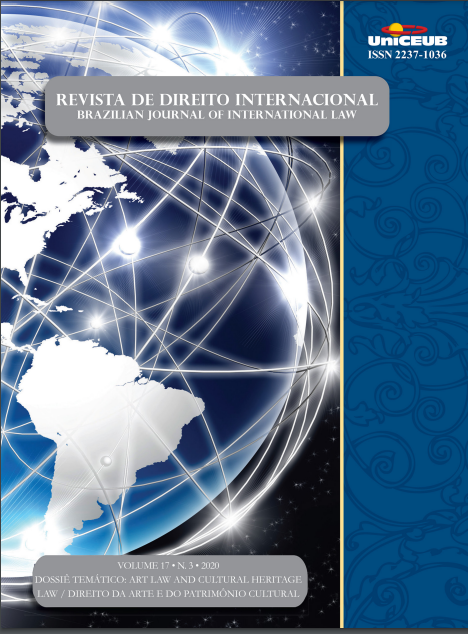
Downloads
Published
Issue
Section
License
Authors who publish with this journal agree to the following terms:
a) Authors retain copyright over their work and grant the journal the right of first publication, with the work simultaneously licensed under a Creative Commons Attribution 4.0 International License (CC BY 4.0), which allows others to share the work with acknowledgement of the work's authorship and its initial publication in this journal.
b) Authors are able to enter into separate, additional contractual arrangements for the non-exclusive distribution of the journal's published version of the work (e.g., post it to an institutional repository or publish it in a book), with an acknowledgement of its initial publication in this journal.
c) Authors are permitted and encouraged to post their work online (e.g., in institutional repositories or on their personal website) prior to and during the submission process, as it can lead to productive exchanges, as well as earlier and greater citation of published work.